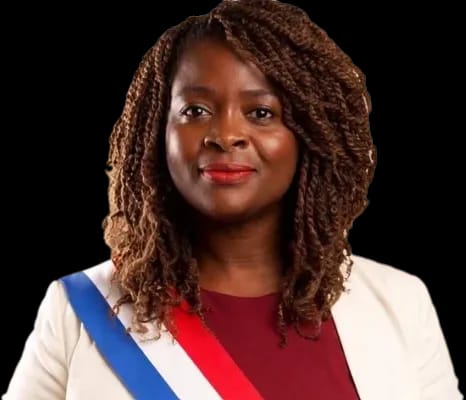
The municipal elections held in France on March 15, 2026—with runoffs in some communes on March 22—marked a historic milestone in the nation’s local governance. For the first time on such a scale, ten mayors of sub-Saharan African descent were elected across France, signaling the growing influence and representation of the African diaspora in French politics.
Spanning rural towns, mid-sized communes, and major suburban cities, these victories reflect both political diversity and the resilience of candidates from immigrant backgrounds. Affiliations range from independents to left-wing parties, notably La France Insoumise (LFI), with strong local coalitions. Notably, three of the elected mayors are women, underscoring the intersection of gender diversity with this historic breakthrough.
Trailblazing Elected Mayors
Leslie Halleur-Echaroux Djoufack (Cameroonian origin) — Mayor of Saint-Mammès (Seine-et-Marne, ~3,200 residents). Elected in the first round with ~50.5%, she becomes the first woman mayor of the commune since 1789. A public finance official, she represents a new era of leadership in local rural governance.
Bally Bagayoko (Malian origin) — Mayor of Saint-Denis (Seine-Saint-Denis, >100,000 residents). Securing ~50.77% in the first round, his victory consolidates LFI’s influence in a historic working-class, immigrant-heavy city. Bagayoko faced post-election racist attacks and disinformation campaigns, highlighting both the challenges and symbolic importance of his achievement.
Yahaya Soukouna — Mayor of Fleury-Mérogis (Essonne).
Marième Tamata-Varin-Watt — Mayor of Yèbles (Seine-et-Marne), one of the women breaking barriers.
Mohamed Gnabaly — Mayor of L’Île-Saint-Denis.
Kwami Agbegna (Togolese
Here’s a polished, publication-ready rewrite that is both powerful and journalistic, highlighting the historic significance and providing a compelling narrative:
African Diaspora Makes Historic Breakthrough in French Local Politics
The municipal elections held in France on March 15, 2026—with runoffs in some communes on March 22—marked a historic milestone in the nation’s local governance. For the first time on such a scale, ten mayors of sub-Saharan African descent were elected across France, signaling the growing influence and representation of the African diaspora in French politics.
Spanning rural towns, mid-sized communes, and major suburban cities, these victories reflect both political diversity and the resilience of candidates from immigrant backgrounds. Affiliations range from independents to left-wing parties, notably La France Insoumise (LFI), with strong local coalitions. Notably, three of the elected mayors are women, underscoring the intersection of gender diversity with this historic breakthrough.
Trailblazing Elected Mayors
Leslie Halleur-Echaroux Djoufack (Cameroonian origin) — Mayor of Saint-Mammès (Seine-et-Marne, ~3,200 residents). Elected in the first round with ~50.5%, she becomes the first woman mayor of the commune since 1789. A public finance official, she represents a new era of leadership in local rural governance.
Bally Bagayoko (Malian origin) — Mayor of Saint-Denis (Seine-Saint-Denis, >100,000 residents). Securing ~50.77% in the first round, his victory consolidates LFI’s influence in a historic working-class, immigrant-heavy city. Bagayoko faced post-election racist attacks and disinformation campaigns, highlighting both the challenges and symbolic importance of his achievement.
Yahaya Soukouna — Mayor of Fleury-Mérogis (Essonne).
Marième Tamata-Varin-Watt — Mayor of Yèbles (Seine-et-Marne), one of the women breaking barriers.
Mohamed Gnabaly — Mayor of L’Île-Saint-Denis.
Kwami Agbegna (Togolese origin) — Mayor of Provin (Nord).
Aly Diouara — Mayor of La Courneuve (Seine-Saint-Denis).
Mélissa Youssouf — Mayor of Villepinte, another pioneering woman.
Adama Gaye — Mayor of Mantes-la-Jolie (Yvelines).
Bassi Konaté — Mayor of Sarcelles (Val-d’Oise).
The elected leaders come from Cameroonian, Malian, Mauritanian, Senegalese, Togolese, Gambian, Comorian, and mixed Mauritanian-Senegalese backgrounds, many rising from community, sporting, and associative leadership roles without traditional party machinery. Their success underscores the power of local engagement, vision, and grassroots mobilization.
Significance and Impact
This wave of African diaspora mayors represents a transformative moment in French politics. It demonstrates the growing integration of immigrant communities into the political mainstream and challenges traditional narratives surrounding identity, governance, and representation. African media has celebrated the elections as a source of pride, while in France, the results spark broader debates on diversity, inclusivity, and the evolution of “la nouvelle France.”
The results also reflect wider electoral trends: higher turnout than in 2020 (~48–57% nationally), fragmented political landscapes, and the decisive role of local alliances. For many observers, the March 15, 2026 elections mark a hopeful step toward inclusive and representative local leadership, affirming that France’s municipal governance is increasingly reflective of its rich, multicultural population.
If you want, I can also condense this into a punchy press release version suitable for immediate publication with headlines, pull quotes, and social media-ready snippets while keeping the historic emphasis strong.
Do you want me to do that next?
) — Mayor of Provin (Nord).
Aly Diouara — Mayor of La Courneuve (Seine-Saint-Denis).
Mélissa Youssouf — Mayor of Villepinte, another pioneering woman.
Adama Gaye — Mayor of Mantes-la-Jolie (Yvelines).
Bassi Konaté — Mayor of Sarcelles (Val-d’Oise).
The elected leaders come from Cameroonian, Malian, Mauritanian, Senegalese, Togolese, Gambian, Comorian, and mixed Mauritanian-Senegalese backgrounds, many rising from community, sporting, and associative leadership roles without traditional party machinery. Their success underscores the power of local engagement, vision, and grassroots mobilization.
Significance and Impact
This wave of African diaspora mayors represents a transformative moment in French politics. It demonstrates the growing integration of immigrant communities into the political mainstream and challenges traditional narratives surrounding identity, governance, and representation. African media has celebrated the elections as a source of pride, while in France, the results spark broader debates on diversity, inclusivity, and the evolution of “la nouvelle France.”
The results also reflect wider electoral trends: higher turnout than in 2020 (~48–57% nationally), fragmented political landscapes, and the decisive role of local alliances. For many observers, the March 15, 2026 elections mark a hopeful step toward inclusive and representative local leadership, affirming that France’s municipal governance is increasingly reflective of its rich, multicultural population.
By Uche EJIMS – Paris
NAIJA DIASPORA MAGAZINE